Project type: Conceptual case study
My role: Solo UX/product designer
Duration: Self-initiated, 2025
Platform: iOS & Android (mobile-first)
GCC banking is undergoing a significant digital shift. Governments across the region — including Oman’s Vision 2040 — are mandating digital-first financial services. Yet most banking apps in the region still force users through the same friction-heavy, branch-dependent onboarding they have used for decades.
Meanwhile, AI is reshaping what onboarding can look like: smart document guidance, real-time KYC assistance, personalised financial insights from day one. The gap between what’s technically possible and what users actually experience in GCC banking is the opportunity this project explores.
” GCC banking users — especially Arabic-first users and digital newcomers — face unnecessarily complex onboarding experiences that rely on branch visits, repeated document uploads, and zero contextual guidance. Existing apps treat onboarding as a compliance checkbox rather than a trust-building moment. As a result, drop-off rates are high, digital adoption stalls, and users begin their banking relationship feeling lost rather than confident.”
This project asks: what if an AI assistant guided users through every step of account opening — explaining KYC requirements in plain Arabic or English, reducing errors before they happen, and surfacing personalised financial insights the moment onboarding is complete?
Slower decision-making for CX managers due to hard-to-access insights.
Lower engagement rates from frontline agents, limiting adoption.
Increased support costs due to frequent user training and inquiries.
of GCC users abandon digital onboarding before completion
average steps required for KYC in regional banking apps
of GCC banking apps offer Arabic-first UX on onboarding flows
* Illustrative benchmark based on regional fintech research. Cited as design hypothesis, not measured outcome.
Sources: MX Technologies Account Opening research; Signicat “Battle to Onboard” report; Fenergo KYC in 2024 global study. Arabic UX gap based on competitive audit of 8 GCC banking apps conducted as part of this case study’s discovery phase.
Framing note: This is a self-initiated conceptual product case study. It is not affiliated with any bank or financial institution. All personas, flows, and metrics are design artefacts created to explore a real and documented UX problem in GCC financial services.
The GCC banking sector is in a documented digital transition. Governments across the region — Oman Vision 2040, Saudi Vision 2030, UAE Digital Economy Strategy — are mandating cashless, digital-first financial services. Despite this, onboarding experiences across the region remain friction-heavy compared to global fintech leaders.
Average digital onboarding drop-off rate globally
Signicat, 2022
Banks lost clients due to inefficient onboarding in 2025
Fenergo, 2025
Onboarding time reduction when AI-assisted verification is used
INSART, 2025
GCC users prefer experiences built for regional context, not translated
LinkedIn / Apptunix, 2024
Audit of 4 representative GCC banks based on publicly available app store data, press releases, and documented digital banking initiatives (2024–2025).
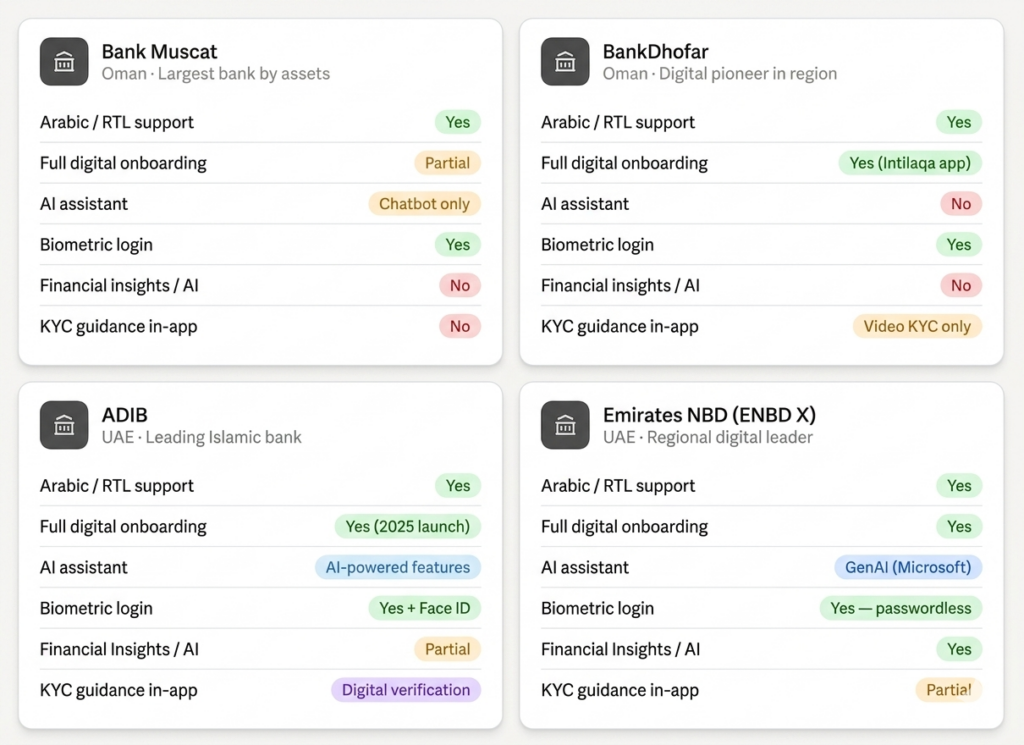
Key audit finding:
even the most advanced GCC banks (Emirates NBD, ADIB) have functional digital onboarding — but none offer a proactive, conversational AI assistant that guides users through KYC in plain Arabic, explains requirements in context, and transitions immediately into personalised financial insights after account opening. That gap is the design opportunity this project addresses.
Process feels too long
More than 50% of users abandon if onboarding takes longer than 3–5 minutes. Most GCC banking apps require multiple sessions, branch visits, or physical document submission. (Altkom Software / The Financial Brand, 2025)
KYC without guidance
Users are asked to upload documents (civil ID, passport, salary certificate) with no in-app explanation of why, what format is needed, or what happens next. Rejection errors cause drop-off. (Fenergo KYC Report, 2024)
Arabic as an afterthought
92% of GCC users prefer native regional experiences — but most banking apps apply RTL as a layout flip, not a true Arabic-first design. Microcopy, error messages, and financial terminology often remain in English only. (GITEX Arabic UX report, 2024)
Low trust, no transparency
Users don’t understand why data is collected or how it is protected. Deepfake fraud attempts during digital onboarding increased 300%+ in 2025 — banks must communicate security clearly, not bury it in terms and conditions. (FacePhi / UAE Cybersecurity Report, 2026)
Zero value after account opening
The moment a user completes onboarding, apps present a generic dashboard with no personalised insights. There is no AI-driven financial summary, no spending guidance, no product recommendation relevant to the user’s stated goals.
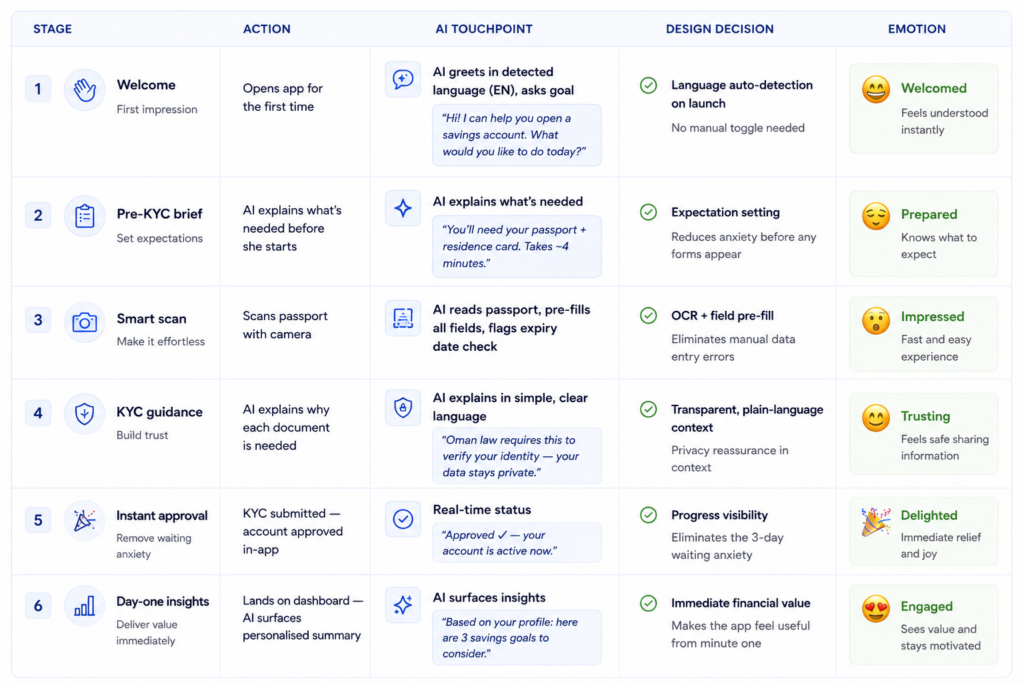
Conversational KYC guidance
AI assistant explains each KYC step in plain Arabic or English, previews what documents are needed, and catches errors before submission — reducing re-submission loops.
Smart document recognition
AI pre-fills form fields from a scanned civil ID or passport, validates expiry dates and quality in real time — removing manual entry and its associated errors.
Transparent trust signals
AI-generated plain-language explanations of why each data point is collected, shown contextually — not buried in a privacy policy link.
Day-one financial insights
Immediately after onboarding, AI surfaces a personalised financial snapshot: spending category benchmarks, savings goal suggestions, product recommendations — making the app valuable from minute one.
Two personas representing the primary GCC user archetypes this product must serve — an Arabic-first local professional, and an English-first expat newcomer.
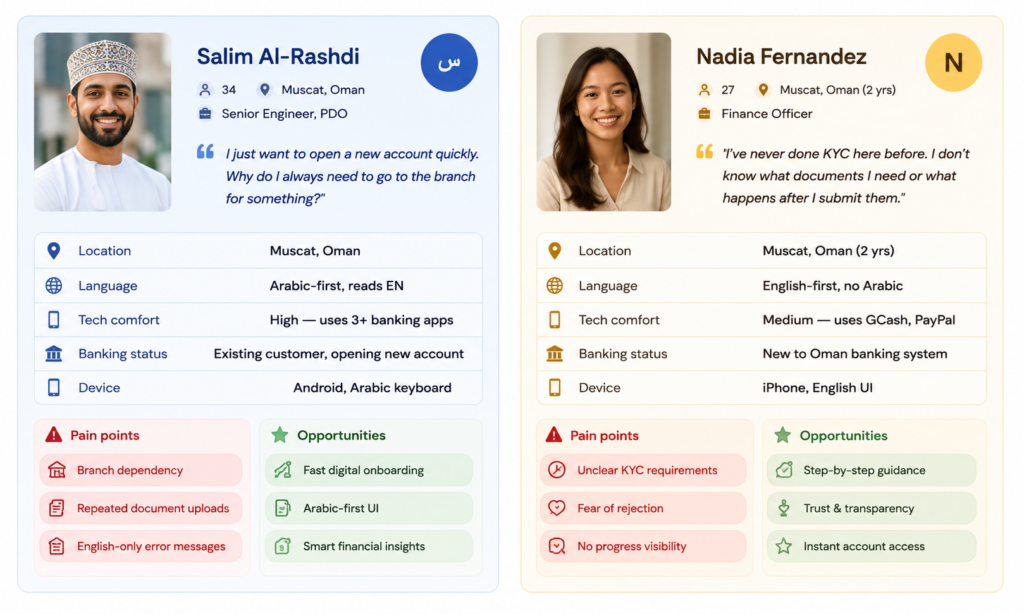
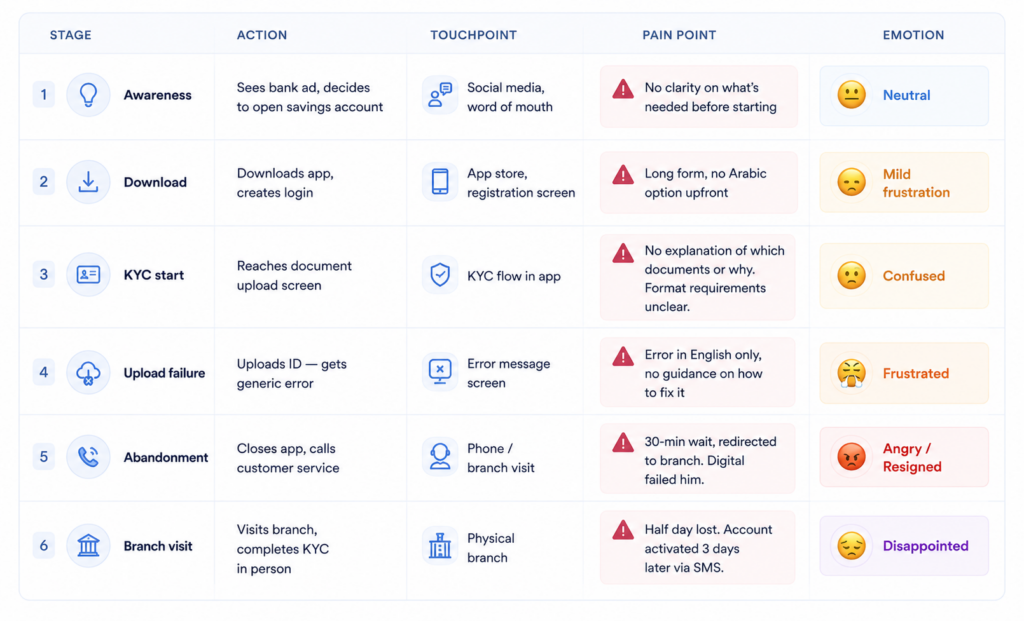
Salim tries to open a secondary savings account digitally. This is the experience most GCC banking apps deliver today.
Same goal — new savings account — but now with the AI-powered onboarding assistant. Nadia’s first-time experience in Oman banking.
✅ Redesigned the main dashboard with a clean, role-based structure.
✅ Implemented Quick Actions for frequently used features.
✅ Consolidated scattered settings into a single, intuitive panel.
✅ Introduced dynamic charts & graphs for better analytics representation.
✅ Added real-time performance tracking for First Contact Resolution (FCR) and Average Handle Time (AHT).
✅ Enabled customizable report filters for tailored data views.
✅ Developed an interactive onboarding assistant.
✅ Integrated tooltips & contextual help for feature explanations.
✅ Designed a learning hub with video tutorials & FAQs.
✅ Predictive Survey Response Model: Helped agents adjust in real-time.
✅ AI-powered recommendations on improving customer interactions.
✅ Integration with communication channels (phone, chat, email, SMS).
After implementing the new design, we conducted a second round of usability testing with 20 users, measuring key performance improvements:
📊 Task Success Rate: Increased from 62% to 91%.
⏳ Time on Task: Reduced by 35%, allowing faster decision-making.
⭐ User Satisfaction Score: Improved from 5.8 to 8.9/10.
📈 Adoption Rate: 40% increase in daily active users.
💰 Support Costs: Reduced by 25%, decreasing training efforts.
💬 “The new dashboard is much easier to navigate – I can find what I need instantly!” – CX Manager
💬 “The AI insights are game-changers. I can anticipate customer issues before they arise.” – Support Team Lead
The redesigned Jibe CX platform resulted in:
✅ Higher user engagement from agents & managers.
✅ Faster access to customer insights, enabling real-time decisions.
✅ Reduced errors & inefficiencies, streamlining CX operations.
✅ Improved executive reporting, aiding strategic planning.